
Savoring Czech: Do You Like It? Exploring Food Preferences (Co ti chutná?)(S02/E17 – daily podcast CZECH YOUR DAY)
 Renata Hrkalová
Expressing preferences in Czech might be pretty confusing.
Let’s have a look at the verb CHUTNAT which is used solely with food and drinks.
CHUTNAT” makes talking about food fun and straightforward. Sure, the sentence structure might sound a tad unusual—“It tastes to me [food item],” anyone? But you’ll soon master it. Focus on the pronouns „mi“ (to me) and „ti“ (to you) to nail it!
Handle With Care: NECHUTNAT
Not a fan of that dish? Easy! Use NECHUTNAT:
- „NECHUTNÁ MI RUKOLA.“ Translation: I don’t like rocket! (literally: It doesn’t taste to me rocket)
Simplify with Plurals
With CHUTNAT, it’s a breeze—no need to worry about changing forms like with other verbs. It’s as simple as:
- Batáty (Sweet Potatoes)
- „Co to je? To jsou batáty. Chutnají ti batáty?“ (What is it? These are sweet potatoes. Do you like sweet potatoes?) (literally: Do (they) taste to you sweet potatoes?)
- „Ano, chutnají mi batáty. Jsou moc dobré.“ (Yes, I like sweet potatoes. They are very good.)
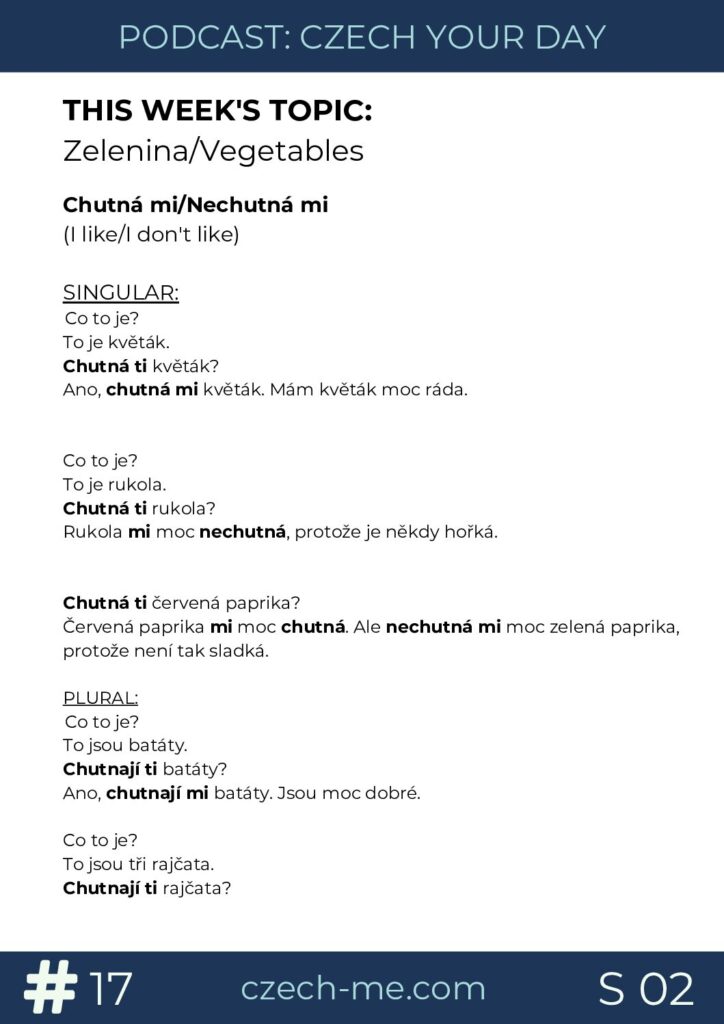
ENGLISH TRANSLATION:
SINGULAR:
Co to je? (What is this?)
To je květák. (This is cauliflower.)
Chutná ti květák? (Do you like cauliflower?)
Ano, chutná mi květák. Mám květák moc ráda. (Yes, I like cauliflower. I like cauliflower very much.)
Co to je? (What is this?)
To je rukola. (This is arugula.)
Chutná ti rukola? (Do you like arugula?)
Rukola mi moc nechutná, protože je někdy hořká. (I don’t like arugula very much because it’s sometimes bitter.)
Chutná ti červená paprika? (Do you like red pepper?)
Červená paprika mi moc chutná. Ale nechutná mi moc zelená paprika, protože není tak sladká. (I like red pepper very much. But I don’t like green pepper very much because it’s not as sweet.)
PLURAL:
Co to je? (What is this?)
To jsou batáty. (These are sweet potatoes.)
Chutnají ti batáty? (Do you like sweet potatoes?)
Ano, chutnají mi batáty. Jsou moc dobré. (Yes, I like sweet potatoes. They’re very good.)
Co to je? (What is this?)
To jsou tři rajčata. (These are three tomatoes.)
Chutnají ti rajčata? (Do you like tomatoes?)

 Czech Your Day Community: What is it?
How to experience the same progress and fun as Renča's students from…
 Czech Your Preferences: Reflecting on 20 and Now (KDYŽ MI BYLO DVACET, RÁDA JSEM CESTOVALA)(S02/E58 – daily podcast CZECH YOUR DAY)
Let's practice preferences in Czech both in the present and the past.…
-
-
 Czech Your Day Community: What is it? 14.1.2026
 -

-

-

-

-
-